
Julius AI
Julius AI represents the next evolution of business intelligence—where conversational AI meets advanced analytics to create faster, more accessible data-driven decision making. By removing technical barriers to data analysis, Julius empowers organizations to unlock their data’s full potential without needing data science teams.
Introduction
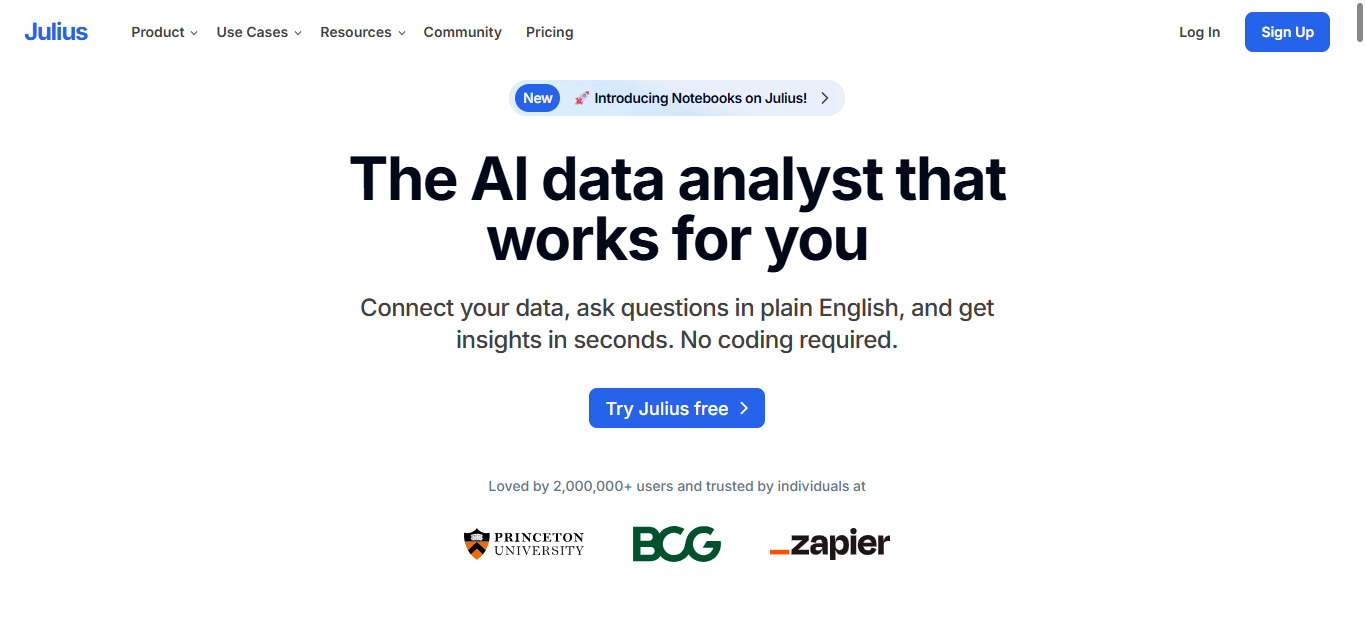
In today’s data-driven world, Julius AI is transforming how businesses and analysts work with data by combining conversational AI with advanced analytics. This revolutionary platform allows anyone to analyze complex datasets, generate insights, and create visualizations using simple natural language commands—no coding or technical expertise required.
Why Julius AI Stands Out
Julius redefines data analysis with these key advantages:
💬 Chat-Based Analytics – Ask questions in plain English
📊 Automated Insights – AI identifies trends and patterns
🔄 Live Data Connectivity – Works with your existing databases
🎨 Smart Visualizations – Auto-generates charts and reports
🤝 Team Collaboration – Share and discuss findings
Key Features That Make Julius Essential
1. Natural Language Processing
Ask data questions conversationally
Understands business terminology
Clarifies ambiguous requests
2. Advanced Analytics Engine
Statistical analysis
Predictive modeling
Anomaly detection
Scenario simulations
3. Data Connectivity
Connect to SQL databases
Import CSV/Excel files
Live API connections
Google Sheets integration
4. Automated Reporting
Generate PowerPoint-ready decks
Scheduled report delivery
Custom branding options
5. Enterprise-Grade Security
SOC 2 compliant
Role-based access control
Data encryption at rest/in-transit
Who Needs Julius AI?
1. Business Analysts
Reduce time spent on manual analysis
Discover hidden insights faster
Create stakeholder reports in minutes
2. Data Teams
Augment existing BI tools
Enable self-service analytics
Reduce repetitive requests
3. Executives & Managers
Get real-time business snapshots
Model “what-if” scenarios
Make data-driven decisions confidently
4. Small Business Owners
Understand customer behavior
Optimize operations
Compete with enterprise analytics
Julius AI Pricing Options
| Plan | Price | Features | Best For |
|---|---|---|---|
| Starter | $39/month | Basic analysis, 5 data sources | Individuals |
| Professional | $99/month | Advanced modeling, 15 sources | Analysts |
| Enterprise | Custom | Unlimited sources, API access | Organizations |
Julius vs. Traditional BI Tools
| Feature | Julius | Tableau | Power BI |
|---|---|---|---|
| Learning Curve | Minutes | Weeks | Weeks |
| Setup Time | Hours | Days | Days |
| Natural Language | ✅✅ | ✅ | ✅ |
| Advanced Analytics | ✅✅ | ✅ | ✅ |
✅ Julius Advantages:
✔ Democratizes data analysis
✔ 10x faster insights
✔ More conversational interface
❌ Limitations:
Less customizable than full BI suites
Newer platform with fewer integrations
Getting Started with Julius
1️⃣ Connect your data sources
2️⃣ Ask questions in plain English
3️⃣ Explore AI-generated insights
4️⃣ Share findings with your team
Success Stories
📈 E-Commerce Director
“Identified $250K in missed revenue opportunities through Julius’ automated insights.”
🏦 Financial Analyst
“Reduced monthly reporting time from 20 hours to 2 hours.”
Julius Ecosystem
Template Library – Common business analyses
API Documentation – Custom integrations
Community Forum – Share use cases
Frequently Asked Questions
1. What data sources are supported?
SQL, CSV, Excel, Google Sheets, and 50+ SaaS connectors.
2. Is technical knowledge required?
No—designed for business users first.
3. How accurate are the insights?
Accuracy depends on data quality—always review suggestions.
4. Can I share analyses with my team?
Yes, with commenting and version control.
5. Is my data secure?
Yes, enterprise-grade security protocols.
Conclusion
Julius AI represents the next evolution of business intelligence—where conversational AI meets advanced analytics to create faster, more accessible data-driven decision making. By removing technical barriers to data analysis, Julius empowers organizations to unlock their data’s full potential without needing data science teams.